

@Korisnik i saw what u wrote in this forum: https://penpal-gate.net/forum/12-everyday-life-and-customs/13343-freedom/ and i thought maybe u like this forum too on page 7 bc we talked abt the SAME painting so i hope that maybe u like it!!! 🙂
🤷♀️🖼️ What do you think of this art? 🖌️👩🎨
Dagelijks leven en gewoonten
- 1.668
- 16
- 152
@Korisnik i saw what u wrote in this forum: https://penpal-gate.net/forum/12-everyday-life-and-customs/13343-freedom/ and i thought maybe u like this forum too on page 7 bc we talked abt the SAME painting so i hope that maybe u like it!!! 🙂
Thank oyu for letting me know about this forum. @diogenes_cask explained it well. God offers Himself (extended His finger fully) and it's up to us will we accept Him or no - we have free will to accept or reject God and God won't force us to accept Him if we don't want. But we should be aware that all actions has their consequences. I've also read that cardinals told Michelangelo to make fingers that way.
I maybe WAYYY to late but omg I love Starry Night by Vincent van Gogh so much. I don't know what it is but it's fascinating. I have a small puzzle of it, and even as my "normal" Homescreen on my I pad so the background I use at home. And when I was younger and I saw this painting for the first time it was just stuck in my head for days and I always wanted to know how It would feel like being in one of his paintings (especially in Starry Night). I'd sell my sould so see this painting in real life one day. I sometimes even try to daydream about being inside that painting (when I have nothing other to daydream about I usually do this) and I always feel sad when I remember that Van Gogh died thinking he'd never be famous but now his paintings are worth millions. I think he even said it in his last letter to his brother before you know.. and I think he wrote something like "think I am a failure and that is the fate I have to accept" or something and it just makes me so sad. So looking at the painting it's a mix of a calming effect but also an unsettling feeling about the person behind the painting.
Update guys I'm going to Amsterdam next week and we actually got tickets for the van Gogh museum
aangepast door Whatsername_ .
Thank oyu for letting me know about this forum. @diogenes_cask explained it well. God offers Himself (extended His finger fully) and it's up to us will we accept Him or no - we have free will to accept or reject God and God won't force us to accept Him if we don't want. But we should be aware that all actions has their consequences. I've also read that cardinals told Michelangelo to make fingers that way.
Thnxx @Korisnik! 😊😊 We had it in our art history class and i thought maybe it was nice for this forum bc LOTTT of ppl like it but it is also important to talk what maybe the painter means with it. 🙂
Update guys I'm going to Amsterdam next week and we actually got tickets for the van Gogh museum
Abbyyyy @Whatsername_ when are u exactly in Amsterdam???? If u need tips u just tell me and the Van Gogh museum is really nice BUTTT there is often a very long line of ppl. But is really worthwile and also if u need more tips for Amsterdam i can give u a LOTTTT!!!! Maybe u like this forum: https://penpal-gate.net/forum/13-anything-and-everything/9200-amsterdam-any-tips?hl=en but just let me know if u need to know more things and i can share with u. We will maybe be in Amsterdam this Friday afternoon or Saturday later on the day bc my mom said we need to go soon to the Oriental supermarket so perhaps im this weekend also in Amsterdam but not the centre.
Alexandre Cabanel's "L'Ange déchu".
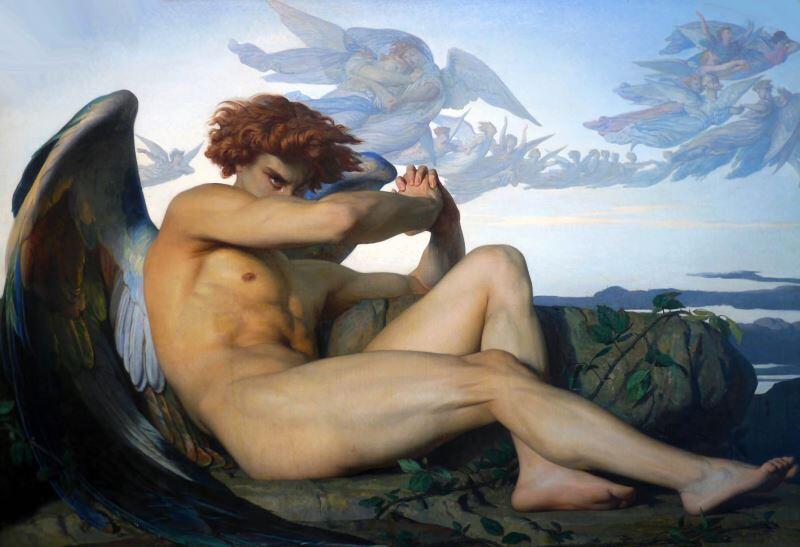
When you first look at the painting, you see a winged young man with a flawless physique—reminiscent of an ancient Greek statue—sitting on a rocky surface. His arms are raised, his fingers interlaced, concealing the lower part of his face. In the background, angels—the very ones who cast him down—drift through the sky. Yet, the focal point of the painting is his eyes: bloodshot, brimming with rage, and fixed on vengeance. And then, there is a single tear tracing its way down—a tear that transforms the entire painting.
I was deeply moved the first time I saw this painting—in fact, it affects me every single time I look at it. I believe it is the tear in the painting that makes it so iconic; without that tear, we would simply be looking at evil itself. With the tear, however, we see a being who knows it has been defeated—a being enduring the pain of rejection, a shattered ego, and utter helplessness. And take note of the wings: the feathers near the top remain pure white, while the tips that touch the ground have begun to darken. It is as if this being has been torn away from heaven, yet has not truly found a place on earth.
The inspiration for Cabanel’s painting was John Milton’s epic Paradise Lost, published in 1667. In the epic, Satan is a tragic figure who defends his rebellion to the bitter end, famously declaring, "Better to reign in Hell, than serve in Heaven!" However, Milton’s work begins while Satan is already in Hell. Cabanel, by contrast, chose a different moment: the very instant of Satan’s fall. He is neither the angel in Heaven nor the ruler in Hell; he exists in the space between—a being who has just realized that he has lost everything. And how did the Academy react? As you might guess, they were not impressed. According to historical records, no student at the Villa Medici had ever before submitted a work centered on Satan. The jury deemed the painting overly romantic, dismissing it with the critique: "The movement is incorrect, the drawing is careless, and the execution is inadequate!" Cabanel’s reaction is one that many people today might find relatable; in a letter to his friend and patron Alfred Bruyas, he wrote, "This is the reward for all the effort I put in to avoid submitting a mediocre piece!" In other words, much like the angel he depicted, he found himself rejected precisely at the moment he presented his most ambitious work.
Alexandre Cabanel's "L'Ange déchu".
📸️
When you first look at the painting, you see a winged young man with a flawless physique—reminiscent of an ancient Greek statue—sitting on a rocky surface. His arms are raised, his fingers interlaced, concealing the lower part of his face. In the background, angels—the very ones who cast him down—drift through the sky. Yet, the focal point of the painting is his eyes: bloodshot, brimming with rage, and fixed on vengeance. And then, there is a single tear tracing its way down—a tear that transforms the entire painting.
I was deeply moved the first time I saw this painting—in fact, it affects me every single time I look at it. I believe it is the tear in the painting that makes it so iconic; without that tear, we would simply be looking at evil itself. With the tear, however, we see a being who knows it has been defeated—a being enduring the pain of rejection, a shattered ego, and utter helplessness. And take note of the wings: the feathers near the top remain pure white, while the tips that touch the ground have begun to darken. It is as if this being has been torn away from heaven, yet has not truly found a place on earth.
The inspiration for Cabanel’s painting was John Milton’s epic Paradise Lost, published in 1667. In the epic, Satan is a tragic figure who defends his rebellion to the bitter end, famously declaring, "Better to reign in Hell, than serve in Heaven!" However, Milton’s work begins while Satan is already in Hell. Cabanel, by contrast, chose a different moment: the very instant of Satan’s fall. He is neither the angel in Heaven nor the ruler in Hell; he exists in the space between—a being who has just realized that he has lost everything. And how did the Academy react? As you might guess, they were not impressed. According to historical records, no student at the Villa Medici had ever before submitted a work centered on Satan. The jury deemed the painting overly romantic, dismissing it with the critique: "The movement is incorrect, the drawing is careless, and the execution is inadequate!" Cabanel’s reaction is one that many people today might find relatable; in a letter to his friend and patron Alfred Bruyas, he wrote, "This is the reward for all the effort I put in to avoid submitting a mediocre piece!" In other words, much like the angel he depicted, he found himself rejected precisely at the moment he presented his most ambitious work.
I may be mistaken, but I seem to recall having seen this work on one of my work related trips in southern France. It is a true masterpiece - albeit not my immediate artistic flavour of choice. I appreciate the admiration as presented in your post above and will gratefully use your commentary to revisit any personal thoughts.
I may be mistaken, but I seem to recall having seen this work on one of my work related trips in southern France. It is a true masterpiece - albeit not my immediate artistic flavour of choice. I appreciate the admiration as presented in your post above and will gratefully use your commentary to revisit any personal thoughts.
Yes, your memory serves you right, it is currently stored at the Musee Fabre in Montpellier.
Thnxxx very much for posting it @diogenes_cask!!! Tbh i dont know that painting and i think it is beautiful how it is made BUTTT i think it also looks bit dark and scary mood. Bc how he looks is NOTTT like how u think of an angel and also if u look at the wings it is dark and not white but in a way that it LOOKS like it is almost the same as the rocks ORRR that maybe they are even made of rocks. So then it becomes like an angel which is evil or angry or with negative feeling. So i think that there is smt about that the painter maybe means to say.
✨ ALSOOO i have a question for everybody:
We have now a topic for art history class and although it is on Wednesday we have to already think abt it but it is NOTTTT for a grade. It says that in some countries in Scotland they have now rules and they say it is forbidden to show in museums for example mummies or other parts of humans if they are dead. And it says that they do that bc of privacy of that person EVEN if the mummy is dead for more than 2000 years. But other museums said they will still show it bc it can be important for history or art and science. And now we have to think what we agree with the most and what we think is right but i think u can say BOTH can be right and it just depends what that person thinks. I think it is ok if u show a mummy which is really old if it is for an important museum exhibition abt Egypt or similar things bc that is also history AND art. But i also understand that u dont know if that person has a problem with it so it is a difficult choice. 🙄🙄